
CHINESE JOURNAL OF PARASITOLOGY AND PARASITIC DISEASES ›› 2026, Vol. 44 ›› Issue (3): 429-436.doi: 10.12140/j.issn.1000-7423.2026.03.017
• ORIGINAL ARTICLES • Previous Articles Next Articles
WU Yunqimuge1( ), DAO Jiahao1, CAI Ran1, FU Songqing1, RUAN Xingyu1, SHAN Yuwei1, FU Yating1, HU Wei1,2,*(
 )()
)()
Received:2026-02-02
Revised:2026-03-22
Online:2026-06-30
Published:2026-06-23
Contact:
*E-mail:huw@fudan.edu.cn
Supported by:CLC Number:
WU Yunqimuge, DAO Jiahao, CAI Ran, FU Songqing, RUAN Xingyu, SHAN Yuwei, FU Yating, HU Wei. Establishment of a colloidal gold immunochromatographic assay for rapid detection of Cryptosporidium parvum, Giardia lamblia and Eimeria bovis[J]. CHINESE JOURNAL OF PARASITOLOGY AND PARASITIC DISEASES, 2026, 44(3): 429-436.
Add to citation manager EndNote|Ris|BibTeX
URL: https://www.jsczz.cn/EN/10.12140/j.issn.1000-7423.2026.03.017
Table 1
Primers for PCR amplification of E. bovis hsp90, C. parvum cgd2-420, and G. lamblia α-15 giardin genes
| 基因名 Gene name | 引物序列(5'→3') Primer sequence (5'→3') | 扩增长度/bp Amplicon length/bp |
|---|---|---|
| cgd2-420 | F:GGCTCACAGAGAACAGATTGGTGGCCAAGGATCCAACCAGCTGGGTCGTGTGGATGAACATAGTAAAA | 570 |
| R:GCCGGATCTCAGTGGTGGTGGTGGTGGTGCTCGAGAAAACGACCTTTCAGTTTACTACAGCGCGGGGTG | ||
| α-15 giardin | F:GACTGGTGGACAGCAAATGGGTCGCGGATCCATGGACCATATCAGTCTGTGTACCGAACTGCATC | 921 |
| R:AGCAGCCGGATCTCAGTGGTGGTGGTGGTGGTGCTCGAGCGGGCACAGACTCGGAATACCCCACA | ||
| hsp90 | F:GACTGGTGGACAGCAAATGGGTCGCGGATCCAAGCCTCTGTGGATGCGTAAACCGGAAGAAGTGACCGAA | 1 293 |
| R:AGCAGCCGGATCTCAGTGGTGGTGGTGGTGGTGCTCGAGACGACGTGCACCTTCAACTTCTTCCAGCGGC |
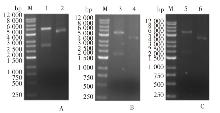
Fig. 1
Double-digestion analysis of the recombinant plasmids pET-28a-hsp90 (A), pSmart-1-cgd2-420 (B), and pET-28a-α-15 giardin (C) M: DNA marker; 1: Double digested pET-28a-hsp90; 2: Undigested pET-28a-hsp90; 3: Double digested pSmart-1-cgd2-420; 4: Undigested pSmart-1-cgd2-420; 5: Double digested pET-28a-α-15 giardin; 6: Undigested pET-28a-α-15 giardin.
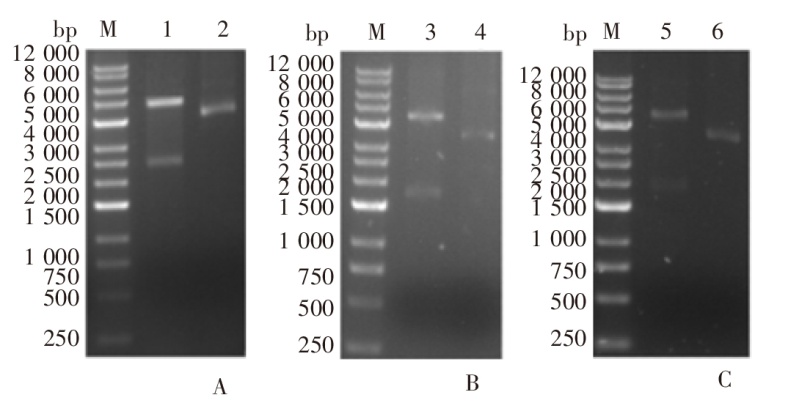
Fig. 2
SDS-PAGE results of recombinant HSP90 (A), cgd2-420 (B), α-15 giardin (C) proteins M: Protein marker; 1, 2: HSP90 samples before and after induction; 3, 4: cgd2-420 samples before and after induction; 5, 6: α-15 giardin samples before and after induction.
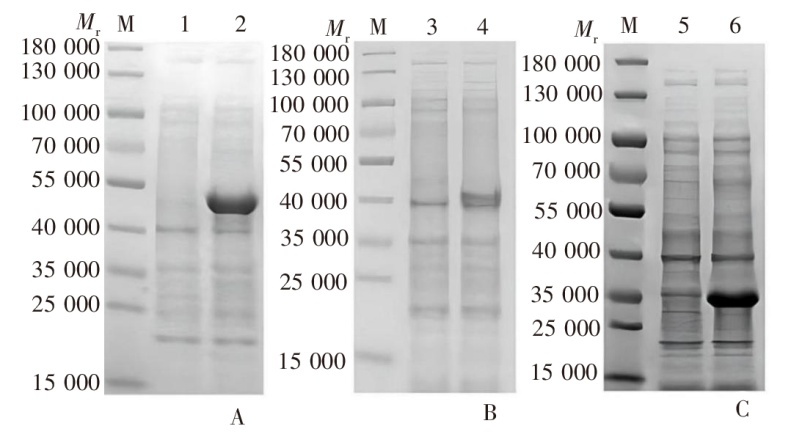
Fig. 3
SDS-PAGE results of purified recombinant HSP90 (A), cgd2-420 (B), α-15 giardin (C) proteins M: Protein marker; 1: Bacterial cell lysis solution after induction; 2: Supernatant protein; 3: Flow-through fraction; 4: Elution solution.
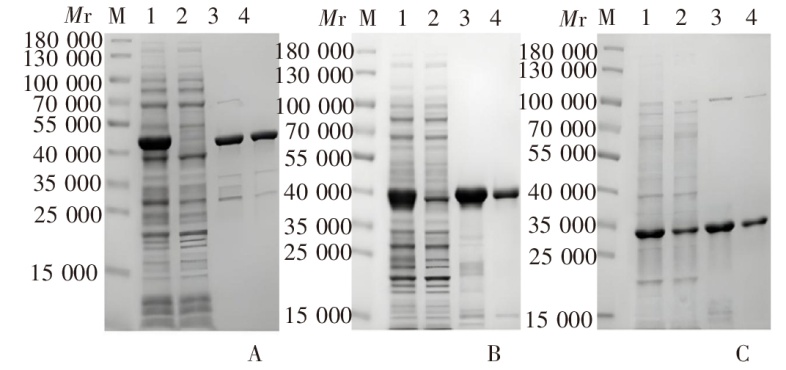
Table 2
Determination of titers of ascites monoclonal antibodies against E. bovis, C. parvum and G. lamblia
| 单克隆抗体 Monoclonal antibody | 不同浓度抗原下的效价 Titer at different antigen concentrations | |||||||
|---|---|---|---|---|---|---|---|---|
| 1 000 ng/mL | 250 ng/mL | 62.5 ng/mL | 15.625 ng/mL | 3.906 ng/mL | 0.976 ng/mL | 0.244 ng/mL | 0 | |
| 牛艾美球虫 E. bovis | ||||||||
| HP1 | 2.975 | 2.780 | 1.881 | 0.979 | 0.420 | 0.185 | 0.108 | 0.110 |
| HP2 | 3.175 | 3.097 | 2.082 | 2.118 | 1.149 | 0.575 | 0.324 | 0.115 |
| HP3 | 2.557 | 2.507 | 2.434 | 2.154 | 1.602 | 0.881 | 0.528 | 0.155 |
| HP4 | 2.929 | 2.864 | 2.773 | 2.412 | 1.581 | 0.903 | 0.446 | 0.086 |
| 微小隐孢子虫 C. parvum | ||||||||
| CG1 | 1.107 | 1.099 | 1.161 | 0.831 | 0.276 | 0.119 | 0.072 | 0.066 |
| CG2 | 2.634 | 2.585 | 2.578 | 2.265 | 1.376 | 0.562 | 0.227 | 0.086 |
| CG3 | 1.880 | 1.650 | 1.844 | 1.718 | 1.090 | 0.366 | 0.134 | 0.061 |
| CG4 | 2.216 | 2.202 | 2.014 | 2.085 | 1.418 | 0.501 | 0.179 | 0.069 |
| CG5 | 2.816 | 2.849 | 2.779 | 2.587 | 1.733 | 0.632 | 0.228 | 0.082 |
| 蓝氏贾第鞭毛虫 G. lamblia | ||||||||
| JD1 | 2.470 | 1.864 | 0.938 | 0.375 | 0.162 | 0.097 | 0.087 | 0.100 |
| JD2 | 1.955 | 1.528 | 0.766 | 0.474 | 0.144 | 0.078 | 0.070 | 0.090 |
| JD3 | 2.382 | 1.806 | 1.012 | 0.323 | 0.156 | 0.097 | 0.078 | 0.096 |
| JD4 | 2.547 | 1.910 | 1.066 | 0.411 | 0.154 | 0.074 | 0.055 | 0.059 |
| JD5 | 2.611 | 1.963 | 1.077 | 0.419 | 0.155 | 0.075 | 0.060 | 0.062 |

Fig. 4
Sensitivity of the colloidal gold immunochromatographic strip for diagnosis of E. bovis, C. parvum, and G. lamblia

Fig. 5
Cross-reactivity of the colloidal gold immunochromatographic strip for detection of E. bovis, C. parvum, and G. lamblia A1: E. bovis positive sample; A2: E. bovis negative sample; A3: C. parvum positive sample; A4: C. ryanae positive sample; A5: G. lamblia positive sample; A6: E. zuernii positive sample; B1: C. parvum positive sample; B2: C. parvum negative sample; B3: C. ryanae positive sample; B4: G. lamblia positive sample; B5: E. zuernii positive sample; B6: E. bovis positive sample; C1: G. lamblia positive sample; C2: G. lamblia negative sample; C3: C. ryanae positive sample; C4: C. parvum positive sample; C5: E. zuernii positive sample; C6: E. bovis positive sample.
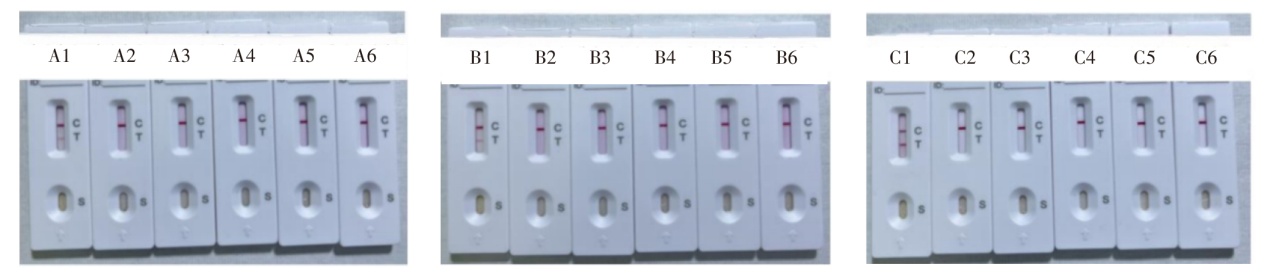
Table 3
Comparison of the performance of the E. bovis, C. parvum, and G. lamblia colloidal gold immunochromatographic strip for detection of clinical samples
| 虫种 Species | 真阳性 TP (+/+) | 假阳性 FP (-/+) | 假阴性 FN (+/-) | 真阴性 TN (-/-) | 合计 Total | 阳性预测值/% PPV/% | 阴性预测值/% NPV/% |
|---|---|---|---|---|---|---|---|
| 牛艾美球虫 E. bovis | 39 | 4 | 1 | 36 | 80 | 90.70 | 97.30 |
| 微小隐孢子虫 C. parvum | 6 | 2 | 1 | 71 | 80 | 75.00 | 98.61 |
| 蓝氏贾第鞭毛虫 G. lamblia | 9 | 1 | 2 | 68 | 80 | 90.00 | 97.14 |
|
| [1] | YU Shukun, LIU Lang, CUI Ziyan, TAN Yaxin, HUANG Shunkai, TAO Zhiyang. Pathogenic diagnosis and phylogenetic analysis of Giardia lamblia from an infected case [J]. CHINESE JOURNAL OF PARASITOLOGY AND PARASITIC DISEASES, 2026, 44(3): 448-453. |
| [2] | WU Longfei, XU Huiyan, YU Changhong, CHEN Xinyi, LI Junqiang, ZHANG Sumei, ZHANG Longxian. Preparation and assessment of qualitative reference materials for detection of Cryptosporidium parvum nucleic acid [J]. CHINESE JOURNAL OF PARASITOLOGY AND PARASITIC DISEASES, 2026, 44(2): 260-265. |
| [3] | CUI Lijun, LI Teng, SHEN Yujuan, ZHANG Jing, ZHOU Hao, CAO Jianping. Mechanism of cGAS-STING regulation of immune responses against Cryptosporidium parvum infection in intestinal epithelial cells [J]. CHINESE JOURNAL OF PARASITOLOGY AND PARASITIC DISEASES, 2025, 43(3): 311-316. |
| [4] | PENG Xiaoxue, WANG Xu, JIAN Jinhua, SHEN Yujuan. Giardia lamblia infection in the population and foodborne contamination in China [J]. CHINESE JOURNAL OF PARASITOLOGY AND PARASITIC DISEASES, 2025, 43(2): 274-281. |
| [5] | MIN Xiangyang, FENG Meng, ZHAO Xuhong, WENG Wenhao, LI Hanhua. Diagnosis of a case of Giardia lamblia infection [J]. CHINESE JOURNAL OF PARASITOLOGY AND PARASITIC DISEASES, 2024, 42(2): 272-274. |
| [6] | YANG Ling, WANG Long, WANG Jiayang, ZHOU Kunzheng, YAN Baolong, ZHAO Wei, HUANG Huicong. Expression of Cryptosporidium parvum GP900829-1099 protein and its immunomodulatory effects on mouse macrophages cells [J]. CHINESE JOURNAL OF PARASITOLOGY AND PARASITIC DISEASES, 2024, 42(1): 55-62. |
| [7] | WANG Dan, HE Zhiquan, LIU Ying, LIU Lingzhi, CHEN Huihui, JIANG Tiantian, JI Penghui, QIAN Dan, YANG Chengyun, ZHANG Hongwei. Molecular identification and genetic tracing of Giardia lamblia isolated from an infected case [J]. CHINESE JOURNAL OF PARASITOLOGY AND PARASITIC DISEASES, 2023, 41(3): 380-383. |
| [8] | LI Teng, SHEN Yu-juan, CUI Li-jun, LIU Hua, HU Yuan, JIANG Yan-yan, CAO Jian-ping. Long non-coding RNA NEAT1 involves in intestinal epithelial cell response against Cryptosporidium parvum infection via regulating IL-8 expression [J]. CHINESE JOURNAL OF PARASITOLOGY AND PARASITIC DISEASES, 2022, 40(4): 487-492. |
| [9] | CHEN Yuan-cai, HUANG Jian-ying, LI Jun-qiang, ZHANG Long-xian. Molecular epidemiology and subtype distribution of Cryptosporidium parvum from dairy cattle in China [J]. CHINESE JOURNAL OF PARASITOLOGY AND PARASITIC DISEASES, 2022, 40(3): 278-284. |
| [10] | LI Shu-ning, LI Wen-lin, SHEN Hai-e, WANG Yang, TIAN Xi-feng. Giardia lamblia trophozoites induce the formation of neutrophil extracellular traps in vitro [J]. CHINESE JOURNAL OF PARASITOLOGY AND PARASITIC DISEASES, 2021, 39(4): 455-460. |
| [11] | YU Ming-chuan, YANG Zhong-wei, WANG Hua-ran, SHI Dan-yang, ZHOU Shu-qing, YIN Jing, SUN Shu-min. Establishment of a Giardia lamblia detection method based on the LAMP microfluidic chip [J]. CHINESE JOURNAL OF PARASITOLOGY AND PARASITIC DISEASES, 2021, 39(3): 402-405. |
| [12] | Hua LIU, Ning XU, Yu-juan SHEN, Yuan HU, Jian-ping CAO. Infection and genotype of Giardia lamblia among HIV/AIDS patients in Guangxi [J]. CHINESE JOURNAL OF PARASITOLOGY AND PARASITIC DISEASES, 2019, 37(3): 321-325. |
| [13] | Yi-xue YUAN, Guo-xia ZHENG, Dan-dan WANG, Hang ZHUAN, Meng DU, Yun-hua WANG. Cloning and expression of the nucleoside diphosphate kinase gene of Giardia lamblia [J]. CHINESE JOURNAL OF PARASITOLOGY AND PARASITIC DISEASES, 2019, 37(2): 190-193. |
| [14] | Fen FANG, Zhe LIU, Gui-jun WANG, Qian-ming XU. In vivo characterization of mouse dendritic cells infected with Cryptosporidium parvum in the presence of Toll-like receptor 4 [J]. CHINESE JOURNAL OF PARASITOLOGY AND PARASITIC DISEASES, 2017, 35(3): 265-269. |
| [15] | Xiao-jie LIU, Tie-bo MAO, Rui ZHOU. The role of innate immunity in defending against infection with Cryptosporidium parvum [J]. CHINESE JOURNAL OF PARASITOLOGY AND PARASITIC DISEASES, 2017, 35(2): 185-192. |
| Viewed | ||||||
|
Full text |
|
|||||
|
Abstract |
|
|||||
