Curriculum optimization for integration of One Health into schistosomiasis teaching: an empirical study based on an integrated human-animal-environment framework

CHINESE JOURNAL OF PARASITOLOGY AND PARASITIC DISEASES ›› 2026, Vol. 44 ›› Issue (3): 437-442.doi: 10.12140/j.issn.1000-7423.2026.03.018

• TEACHING RESEARCH • Previous Articles     Next Articles

Curriculum optimization for integration of One Health into schistosomiasis teaching: an empirical study based on an integrated human-animal-environment framework

DONG Ke1()(), HUANG Jiewen2, LI Qingtian2, LV Chao1,3, XU Jing1,3, ZHOU Xiaonong1,3, GUO Xiaokui1, ZHU Yongzhang1,*()()   

  1. 1 School of Global Health, Shanghai Jiao Tong University School of Medicine-National Institute for Tropical Diseases, Shanghai 200025, China
    2 School of Medical Technology, Shanghai Jiao Tong University School of Medicine, Shanghai 200025, China
    3 National Institute of Parasitic Diseases, Chinese Center for Disease Control and Prevention; Chinese Center for Tropical Diseases Research; National Key Laboratory of Intelligent Tracking and Forecasting for Infectious Diseases; Key Laboratory on Parasite and Vector Biology, Ministry of Health; WHO Collaborating Centre for Tropical Diseases; National Center for International Research on Tropical Diseases, Ministry of Science and Technology, Shanghai 200025, China
  • Received:2026-03-02 Revised:2026-06-06 Online:2026-06-30 Published:2026-06-23
  • Contact: *E-mail:yzhzhu@sjtu.edu.cn
  • Supported by:
    Shanghai Municipal Education Commission Program for Building Experimental Technical Teams in Shanghai Higher Education Institutions (Hu Jiao Wei [2025] 12);Shanghai Association of Higher Education(2QYB24053);National Clinical Skills Experimental Teaching Demonstration Center, Shanghai Jiao Tong University School of Medicine (Hu Jiao Yi Jiao [2024] 16)

Abstract:

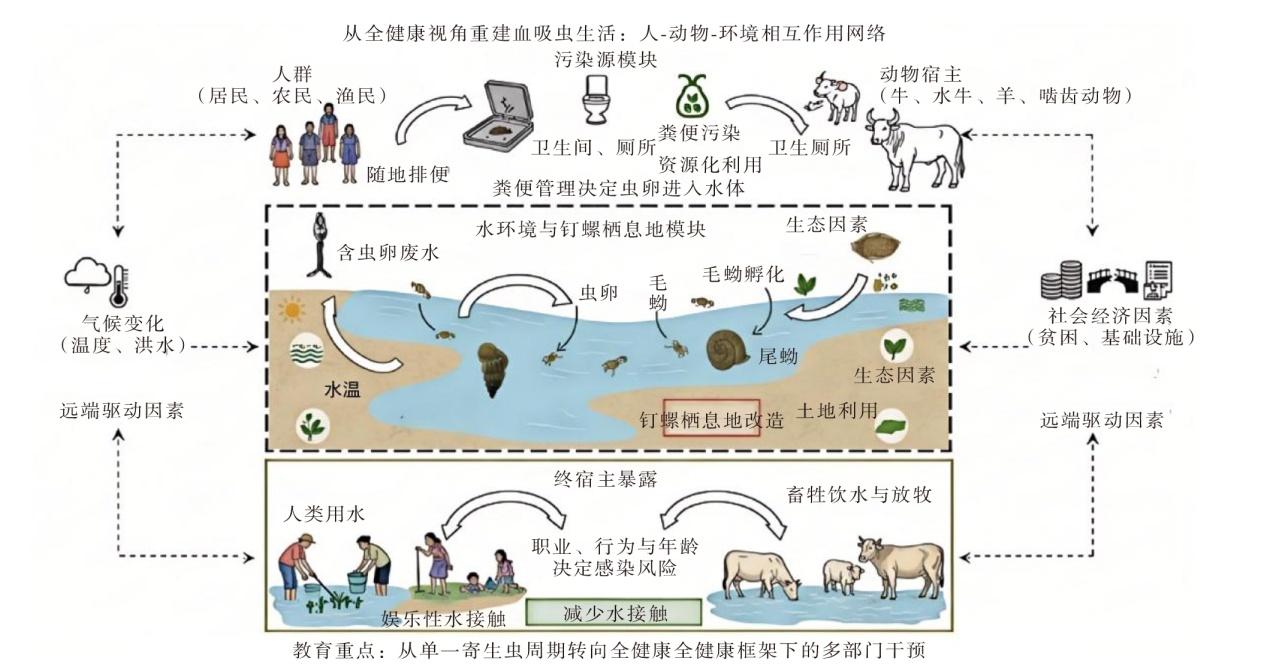
Objective As the national schistosomiasis control program enters a new phase in China and the core content of parasitology curricula remains overall stable, this study aimed to explore the specific pathway for systematically integrating the One Health concept into the current human-animal-environment teaching framework, investigate the evidence for cognitive construction and competency development and develop an operable instructional design model. Methods Based on the current medical parasitology courses and non-adjustment of essential schistosomiasis knowledge points and allocated class hours, the knowledge structure and classroom activity chain supporting active construction and situated learning were constructed through reshaping human-animal-environment-related contents across three modules (life cycle, pathogenesis, and public health control) based on literature analysis and summarizing current status of medical parasitology teaching, under the guidance of constructivist meaning-making, situated learning, and constructive alignment, and a teaching procedure was developed that included scenario-based introduction, case analysis, group scenario simulation and diversified assessment. The outcome measure was the percentage of the score for schistosomiasis items in the total score for parasitology items in the end-of-term pathogenic biology examination between the experimental and control classes during each session. Homogeneity of variance was tested before between-group comparisons, and difference of means between groups was compared with two-sided Welch’s two-sample t tests. Results A “source of infection-aquatic environment-snail habitats-human/animal exposure-disease burden” multi-level representational framework was constructed, which was centered on the life cycle of Schistosoma and coincided with the distribution of cognitive load. Based on retainment of core knowledge points of the textbook, this framework explicitly embedded human populations, animal hosts, and environmental factors to provide an external scaffold for diagram integration, so as to generate an integrated human populations-animal hosts-ecological environment three-domain instructional structure. In addition, an “eco-pathogenesis” analytic perspective was introduced into the pathogenesis module as a teaching tool to link pathophysiology and eco-epidemiology. Over four consecutive sessions, results from objective assessments showed no significant difference in the proportion of the score for schistosomiasis items in the total score for schistosomiasis items in the end-of-term pathogenic biology examination between the experimental and control classes in 2021 (73.80% vs. 70.32%; t = 0.800, P > 0.05), and higher percentages in experimental classes than in control classes from 2022 to 2024 [2022: 82.04% vs. 75.78%, t = 2.059, P < 0.05; 2023: 79.46% vs. 70.15%, t = 2.604, P < 0.05; 2024: 73.06% vs. 65.16%, t = 2.645, P < 0.05], with 6% to 9% superiority over the control class. Conclusion Without altering the basic teaching contents of schistosomiasis, structural refinement and contextual reinforcement of the current human-animal-environment framework based on constructivism and situated learning may provide a feasible route to translating One Health into an operable framework for organizing teaching contents and learning activities, rather than a simple overlap perspective. Compared with conventional teaching methods, this model delivers markedly superior teaching outcomes and offers a viable instructional approach to strengthening systematic comprehension and integrated control thinking.

Key words: Schistosomiasis, Medical parasitology teaching, One Health, Human-animal-environment, Situated learning, Empirical study

CLC Number: