
CHINESE JOURNAL OF PARASITOLOGY AND PARASITIC DISEASES ›› 2026, Vol. 44 ›› Issue (4): 557-564.doi: 10.12140/j.issn.1000-7423.2026.04.015
• ORIGINAL ARTICLES • Previous Articles Next Articles
MA Yufang( )(
 ), XU Yan, WANG Yongbin, WANG Longjiang, LI Yuejin, BU Cancan, LV Wenxiang, LI Yuanchang, XU He, ZHANG Shengnan, KONG Xiangli*()
Received:2026-04-27
Revised:2026-06-30
Online:2026-08-30
Published:2026-08-19
Contact:
* E-mail: kongxiangli@email.sdfmu.edu.cnSupported by:CLC Number:
MA Yufang, XU Yan, WANG Yongbin, WANG Longjiang, LI Yuejin, BU Cancan, LV Wenxiang, LI Yuanchang, XU He, ZHANG Shengnan, KONG Xiangli. Epidemiological characteristics and influencing factors of severe cases of imported malaria in Shandong Province from 2015 to 2025[J]. CHINESE JOURNAL OF PARASITOLOGY AND PARASITIC DISEASES, 2026, 44(4): 557-564.
Add to citation manager EndNote|Ris|BibTeX
URL: https://www.jsczz.cn/EN/10.12140/j.issn.1000-7423.2026.04.015
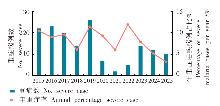
Fig. 1
Annual distribution of imported severe malaria cases in Shandong Province from 2015 to 2025
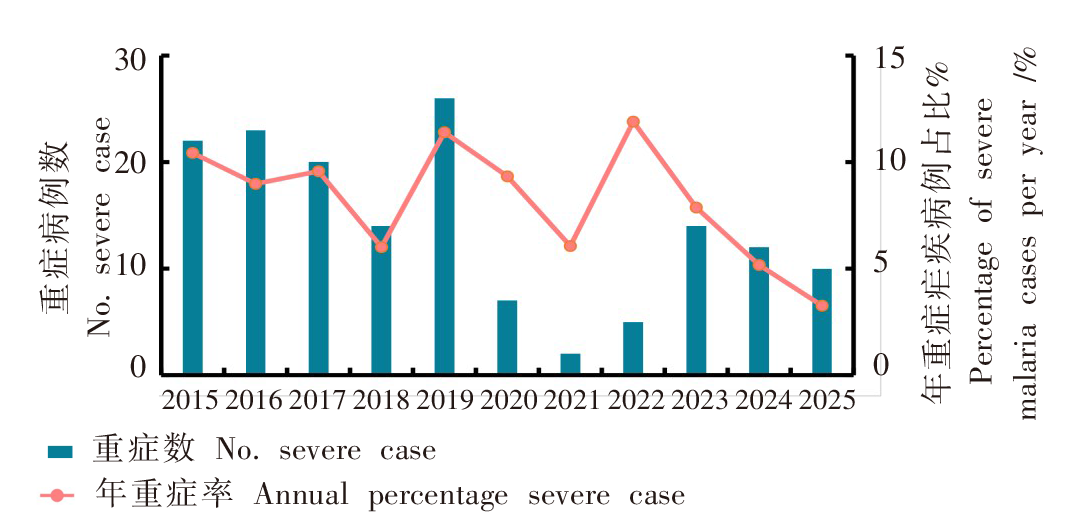

Table 1
Distribution of sources of imported severe malaria cases acquiring infections in Shandong Province from 2015 to 2025
| 感染地来源 Infection source | 感染虫种 Infected species | 合计 Total | 占比/% Percentage/% | |||
|---|---|---|---|---|---|---|
| 恶性疟原虫 P. falciparum | 间日疟原虫 P. vivax | 卵形疟原虫 P. ovale | 三日疟原虫 P. malariae | |||
| 非洲 Africa | ||||||
| 尼日利亚 Nigeria | 16 | 0 | 3 | 0 | 19 | 12.26 |
| 几内亚 Guinea | 15 | 0 | 0 | 0 | 15 | 9.68 |
| 安哥拉 Angola | 11 | 1 | 1 | 0 | 13 | 8.39 |
| 赤道几内亚 The Republic of Equatorial Guinea | 11 | 2 | 0 | 0 | 13 | 8.39 |
| 科特迪瓦 Côte d'Ivoire | 10 | 0 | 1 | 0 | 11 | 7.10 |
| 其他23个国家 Other 23 countries | 74 | 3 | 1 | 1 | 79 | 50.97 |
| 亚洲 Asia | ||||||
| 韩国 Republic of Korea | 0 | 2 | 0 | 0 | 2 | 1.29 |
| 印度尼西亚 Indonesia | 1 | 1 | 0 | 0 | 2 | 1.29 |
| 缅甸 Myanmar | 0 | 1 | 0 | 0 | 1 | 0.65 |
| 总计 Total | 138 | 10 | 6 | 1 | 155 | 100 |
Table 2
Cross-regional healthcare-seeking behaviors among imported severe malaria cases by cities across Shandong Province from 2015 to 2025
| 市 City | 按报告地统计 Statistics according to the report city | 按现住地统计 Statistics according to the present address | |||
|---|---|---|---|---|---|
| 病例数/例 No. case | 跨地区就诊病例数(占比/%)No. case with cross-regional medical visits (proportion/%) | 病例数/例No. case | 跨地区就诊病例数(占比/%)No. case with cross-regional medical visits (proportion/%) | ||
| 济南 Jinan | 37 | 29(78.38) | 9 | 1(1/9) | |
| 青岛 Qingdao | 46 | 9(19.57) | 37 | 0(0) | |
| 淄博 Zibo | 4 | 0(0) | 5 | 1(1/5) | |
| 枣庄 Zaozhuang | 1 | 0(0) | 2 | 1(1/2) | |
| 东营 Dongying | 4 | 0(0) | 6 | 2(2/6) | |
| 烟台 Yantai | 8 | 0(0) | 10 | 2(2/10) | |
| 潍坊 Weifang | 2 | 0(0) | 7 | 5(5/7) | |
| 济宁 Jining | 16 | 5(5/16) | 12 | 1(1/12) | |
| 泰安 Taian | 4 | 0(0) | 13 | 9(9/13) | |
| 威海 Weihai | 10 | 1(1/10) | 10 | 1(1/10) | |
| 日照 Rizhao | 4 | 0(0) | 7 | 3(3/7) | |
| 临沂 Linyi | 16 | 2(2/16) | 18 | 4(4/18) | |
| 德州 Dezhou | 1 | 1(1/1) | 6 | 6(6/6) | |
| 聊城 Liaocheng | 1 | 0(0) | 2 | 1(1/2) | |
| 滨州 Binzhou | 1 | 1(1/1) | 0 | 0(0) | |
| 菏泽 Heze | 0 | 0(0) | 9 | 9(9/9) | |
| 合计 Total | 155 | 48(30.97) | 153 | 46(30.07) | |
Table 3
Univariate analysis of imported severe and non-severe malaria in Shandong Province from 2015 to 2025
| 因素 Variable | 总计 Total | 重症病例 Severe cases | 非重症病例 Non-severe cases | χ2值 χ2 value | P值 P value | |||||
|---|---|---|---|---|---|---|---|---|---|---|
| 病例 No. case | 构成比/% Proportion/% | 病例数No. case | 构成比/% Proportion/% | 病例数No. case | 构成比/% Proportion/% | |||||
| 年龄 Age | 4.372 | 0.037 | ||||||||
| < 30 | 246 | 12.28 | 15 | 9.68 | 231 | 12.49 | ||||
| 30~39 | 577 | 28.79 | 37 | 23.87 | 540 | 29.20 | ||||
| 40~49 | 733 | 36.58 | 60 | 38.71 | 673 | 36.40 | ||||
| 50~59 | 406 | 20.26 | 39 | 25.16 | 367 | 19.85 | ||||
| ≥ 60 | 42 | 2.10 | 4 | 2.58 | 38 | 2.06 | ||||
| 性别 Sex | 4.762 | 0.029 | ||||||||
| 男 Male | 1 970 | 98.30 | 149 | 96.13 | 1 821 | 98.49 | ||||
| 女 Female | 34 | 1.70 | 6 | 3.87 | 28 | 1.51 | ||||
| 国籍 Nationality | 0.641 | 0.423 | ||||||||
| 中国籍 Chinese | 1 960 | 97.80 | 153 | 98.71 | 1 807 | 97.73 | ||||
| 外国籍 Foreign | 44 | 2.20 | 2 | 1.29 | 42 | 2.27 | ||||
| 职业 Occupation | 9.665 | 0.046 | ||||||||
| 务工 Migrant worker | 1 565 | 78.09 | 108 | 69.68 | 1 457 | 78.80 | ||||
| 商业服务 Commercial service workers | 53 | 2.64 | 4 | 2.58 | 49 | 2.65 | ||||
| 家务及待业 Housework & unemployed | 136 | 6.79 | 18 | 11.61 | 118 | 6.38 | ||||
| 干部职员 Cadres and office staff | 124 | 6.19 | 14 | 9.03 | 110 | 5.95 | ||||
| 其他 Others | 126 | 6.29 | 11 | 7.10 | 115 | 6.22 | ||||
| 发病地点 Place of onset | 13.380 | 0.000 | ||||||||
| 国内 Domestic | 1 855 | 92.56 | 132 | 85.16 | 1 723 | 93.19 | ||||
| 国外 Foreign | 149 | 7.44 | 23 | 14.84 | 126 | 6.81 | ||||
| 疟疾史 History of malaria | 59.155 | 0.000 | ||||||||
| 有 Yes | 1 282 | 63.97 | 55 | 35.48 | 1 227 | 66.36 | ||||
| 无 No | 722 | 36.03 | 100 | 64.52 | 622 | 33.64 | ||||
| 初诊机构属性 Nature of initial diagnosis institution | 4.579 | 0.333 | ||||||||
| 省级 Provincial level | 221 | 11.03 | 13 | 8.39 | 208 | 11.25 | ||||
| 市级 Municipal level | 715 | 35.68 | 62 | 40.00 | 653 | 35.32 | ||||
| 县级 County level | 689 | 34.38 | 46 | 29.68 | 643 | 34.78 | ||||
| 县级以下 Below county level | 291 | 14.52 | 28 | 18.06 | 263 | 14.22 | ||||
| 其他 Others | 88 | 4.39 | 6 | 3.87 | 82 | 4.43 | ||||
| 初诊结果 Initial diagnosis | 18.430 | 0.000 | ||||||||
| 疟疾 Malaria | 1 369 | 68.31 | 82 | 52.90 | 1 287 | 69.61 | ||||
| 其他疾病 Other diseases | 635 | 31.69 | 73 | 47.10 | 562 | 30.39 | ||||
| 发病到初诊时间间隔 Onset to initial diagnosis | 1.849 | 0.174 | ||||||||
| 0 d | 600 | 29.94 | 45 | 29.03 | 555 | 30.02 | ||||
| 1~3 d | 991 | 49.45 | 68 | 43.87 | 923 | 49.92 | ||||
| > 3 d | 413 | 20.61 | 42 | 27.10 | 371 | 20.06 | ||||
| 初诊到确诊时间间隔 Initial diagnosis to confirmation | 25.116 | 0.000 | ||||||||
| 0 d | 988 | 49.30 | 52 | 33.55 | 936 | 50.62 | ||||
| 1~3 d | 709 | 35.38 | 60 | 38.71 | 649 | 35.10 | ||||
| > 3 d | 307 | 15.32 | 43 | 27.74 | 264 | 14.28 | ||||
| 疾病类型 Type of disease | 20.261 | 0.000 | ||||||||
| 恶性疟 Falciparum malaria | 1 478 | 73.75 | 138 | 89.03 | 1 340 | 72.47 | ||||
| 非恶性疟 Non-falciparum malaria | 526 | 26.25 | 17 | 10.97 | 509 | 27.53 | ||||
| 跨地区就诊 Cross-regional medical treatment | 15.595 | 0.000 | ||||||||
| 是 Yes | 381 | 19.01 | 48 | 31.00 | 333 | 18.00 | ||||
| 否 No | 1 623 | 80.99 | 107 | 69.00 | 1 516 | 82.00 | ||||
Table 4
Multivariate logistic regression analysis of imported severe malaria in Shandong Province from 2015 to 2025
| 因素 Variable | 分类 Classification | β | SE | Waldχ2 | P | OR | 95% CI |
|---|---|---|---|---|---|---|---|
| 年龄 Age | < 30 | 1 | |||||
| 30~39 | 0.286 | 0.332 | 0.742 | 0.389 | 1.331 | 0.695~2.550 | |
| 40~49 | 0.487 | 0.315 | 2.384 | 0.123 | 1.627 | 0.877~3.017 | |
| 50~59 | 0.730 | 0.333 | 4.814 | 0.028 | 2.076 | 1.081~3.986 | |
| ≥ 60 | 0.515 | 0.615 | 0.701 | 0.402 | 1.674 | 0.501~5.594 | |
| 性别 Sex | 男Male | 1 | |||||
| 女 Female | 0.801 | 0.499 | 2.581 | 0.108 | 2.228 | 0.838~5.919 | |
| 职业 | 务工 Migrant worker | 1 | |||||
| Occupation | 商业服务 Commercial service workers | 0.113 | 0.546 | 0.043 | 0.835 | 1.120 | 0.384~3.266 |
| 家务及待业 Housework & unemployed | 0.688 | 0.287 | 5.748 | 0.017 | 1.989 | 1.134~3.490 | |
| 干部职员 Cadres and office staff | 0.389 | 0.316 | 1.513 | 0.219 | 1.476 | 0.794~2.744 | |
| 其他 Others | 0.213 | 0.349 | 0.373 | 0.541 | 1.237 | 0.625~2.451 | |
| 发病地点 | 国内 Domestic | 1 | |||||
| Place of onset | 国外 Foreign | 0.760 | 0.259 | 8.594 | 0.003 | 2.139 | 1.287~3.555 |
| 疟疾史 | 无 No | 1 | |||||
| History of malaria | 有 Yes | -1.010 | 0.183 | 30.442 | 0.000 | 0.364 | 0.254~0.521 |
| 初诊结果 | 其他疾病 Other diseases | 1 | |||||
| Initial diagnosis | 疟疾 Malaria | -0.284 | 0.208 | 1.858 | 0.173 | 0.753 | 0.500~1.132 |
| 初诊到确诊时间间隔 Initial diagnosis to confirmation | 0 d | 1 | |||||
| 1~3 d | 0.303 | 0.219 | 1.914 | 0.167 | 1.354 | 0.881~2.079 | |
| > 3 d | 0.751 | 0.269 | 7.808 | 0.005 | 2.120 | 1.252~3.591 | |
| 疾病类型 Type of disease | 非恶性疟 Non-falciparum malaria | 1 | |||||
| 恶性疟 Falciparum malaria | 1.029 | 0.275 | 14.040 | 0.000 | 2.798 | 1.633~4.792 | |
| 跨地区就诊 Cross- regional medical treatment | 否 No | 1 | |||||
| 是 Yes | 0.554 | 0.196 | 7.971 | 0.005 | 1.741 | 1.185~2.558 |
|
| [1] | YAN Fang, QI Rongting, MA Tianbo, LIU Xuan, DUAN Hongju, WU Xianglin. Epidemiological characteristics of echinococcosis in Ningxia from 2005 to 2024 [J]. CHINESE JOURNAL OF PARASITOLOGY AND PARASITIC DISEASES, 2026, 44(4): 538-542. |
| [2] | ZHANG Li, XIA Zhigui, LI Shizhu. Epidemiological characteristics of malaria in China, 2025 [J]. CHINESE JOURNAL OF PARASITOLOGY AND PARASITIC DISEASES, 2026, 44(2): 153-157. |
| [3] | YI Jia, LIN Wen, WU Dongni, DONG Xiaorong, SUN Lingcong, ZHU Hong, ZHANG Cong, TU Zhen, XIA Jing. Epidemiological characteristics and laboratory testing of Plasmodium falciparum malaria in Hubei Province from 2020 to 2024 [J]. CHINESE JOURNAL OF PARASITOLOGY AND PARASITIC DISEASES, 2026, 44(2): 271-276. |
| [4] | ZHANG Jiayi, LU Wencheng, WU De, LIU Jun, LIAO Yuhuang, MAO Qiang, CHEN Lijun, DENG Zhuohui, ZHANG Xianchang, XIA Zhigui, CHEN Jingdiao. Epidemiological characteristics of malaria in Guangdong Province from 2015 to 2024 [J]. CHINESE JOURNAL OF PARASITOLOGY AND PARASITIC DISEASES, 2026, 44(1): 42-49. |
| [5] | ZHENG Caifang, HUO Liangliang, XU Minjie, JIN Xingyi, ZHU Sujuan, LIU Shuai, JIN Quan. Determinants of healthcare-seeking and diagnosis among imported malaria cases in Hangzhou City from 2016 to 2024 [J]. CHINESE JOURNAL OF PARASITOLOGY AND PARASITIC DISEASES, 2026, 44(1): 50-56. |
| [6] | YANG Hexian, HUANG Dongsheng, ZHANG Jianling, YIN Gang, MA Lingjuan. Trend of malaria epidemic situation and prevention and control strategies before and after the elimination of malaria in Baoshan City, Yunnan Province [J]. CHINESE JOURNAL OF PARASITOLOGY AND PARASITIC DISEASES, 2025, 43(6): 865-870. |
| [7] | YU Yale, GONG Panlong, ZHAO Qian, CHENG Yanbiao, TIAN Siyang, WANG Tongmin. Epidemiological characteristics of echinococcosis in Xinjiang Production and Construction Corps from 2014 to 2023 [J]. CHINESE JOURNAL OF PARASITOLOGY AND PARASITIC DISEASES, 2025, 43(5): 614-618. |
| [8] | GOU Changchun, LIU Aicong, FENG Kai, CAO Chunli, SONG Xiaoxiao, YUE Taike. Epidemiological characteristics of scrub typhus in Dehong Dai and Jingpo Autonomous Prefecture, Yunnan Province from 2010 to 2024 [J]. CHINESE JOURNAL OF PARASITOLOGY AND PARASITIC DISEASES, 2025, 43(5): 683-689. |
| [9] | ZHU Min, ZHU Guoding, WANG Xiaoxiao, XU Xian, WANG Zhenyu, CAO Yuanyuan, FENG Yan, ZHANG Tao, ZHANG Chengang, ZHANG Xuan, YU Qing. Technical measures for joint prevention and control of imported malaria in the Yangtze River Delta: Experts consensus from Shanghai, Jiangsu, Zhejiang and Anhui [J]. CHINESE JOURNAL OF PARASITOLOGY AND PARASITIC DISEASES, 2025, 43(4): 458-462. |
| [10] | ZHANG Xuan, WANG Xiaoxiao, CHEN Hualiang, ZHANG Jiaqi, XU Wenjie, LU Qiaoyi, FENG Yan, RUAN Wei. Epidemiological characteristics of imported malaria in Zhejiang Province from 2020 to 2024 [J]. CHINESE JOURNAL OF PARASITOLOGY AND PARASITIC DISEASES, 2025, 43(4): 533-539. |
| [11] | JIANG Dianwei, CAI Wuwei, ZHENG Dan, XIE Hanguo, GAO Lanlin. Prevalence and spatial distribution of Fasciola spp. in cattle in Fujian Province [J]. CHINESE JOURNAL OF PARASITOLOGY AND PARASITIC DISEASES, 2025, 43(4): 588-591. |
| [12] | SHEN Guosong, MENG Weidong. Analysis of Trichomonas vaginalis infections among women based on 2016-2023 data from multiple hospitals in Huzhou region [J]. CHINESE JOURNAL OF PARASITOLOGY AND PARASITIC DISEASES, 2025, 43(3): 340-344. |
| [13] | ZHANG Li, XIA Zhigui, LI Shizhu. Epidemiological characteristics of malaria in China, 2024 [J]. CHINESE JOURNAL OF PARASITOLOGY AND PARASITIC DISEASES, 2025, 43(2): 162-166. |
| [14] | ZHU Sujuan, HUO Liangliang, WANG Heng, LIU Shuai, TANG Yi, JIN Xingyi, ZHENG Caifang, XU Minjie. Epidemiological characteristics of schistosomiasis among transient population in Hangzhou City from 2004 to 2023 [J]. CHINESE JOURNAL OF PARASITOLOGY AND PARASITIC DISEASES, 2025, 43(2): 181-186. |
| [15] | NIAN Yunpeng, LI Shanshan, ZHANG Yi, CAO Lei, LIU Dongli, MA Lin, NING Shaoqi, MA Chao, ZHANG Luqian. Epidemiological characteristics of soil-transmitted nematode infections in Shaanxi Province from 2016 to 2023 [J]. CHINESE JOURNAL OF PARASITOLOGY AND PARASITIC DISEASES, 2025, 43(2): 205-209. |
| Viewed | ||||||
|
Full text |
|
|||||
|
Abstract |
|
|||||
