
CHINESE JOURNAL OF PARASITOLOGY AND PARASITIC DISEASES ›› 2026, Vol. 44 ›› Issue (4): 550-556.doi: 10.12140/j.issn.1000-7423.2026.04.014
• ORIGINAL ARTICLES • Previous Articles Next Articles
XU Yun( )(
 ), GONG Zhihong, CHEN Xiaowei, XU Hui, ZHOU Feng, LIU Junpu, FU Ziyang, XIONG Yuping, XIE Huiqun, DING Sheng*()()
Received:2026-04-09
Revised:2026-06-25
Online:2026-08-30
Published:2026-07-22
Contact:
* E-mail: jxcdccfs2@126.comSupported by:CLC Number:
XU Yun, GONG Zhihong, CHEN Xiaowei, XU Hui, ZHOU Feng, LIU Junpu, FU Ziyang, XIONG Yuping, XIE Huiqun, DING Sheng. Epidemiological and clinical characteristics of 174 cases with parasitic infections of the central nervous system in Jiangxi Province[J]. CHINESE JOURNAL OF PARASITOLOGY AND PARASITIC DISEASES, 2026, 44(4): 550-556.
Add to citation manager EndNote|Ris|BibTeX
URL: https://www.jsczz.cn/EN/10.12140/j.issn.1000-7423.2026.04.014
Fig. 1
Imaging findings of selected cases with parasitic infections of the central nervous system in Jiangxi Province A: Cerebral sparganosis, with nodular enhancement in the left temporo-occipital lobe presenting the “knot sign”; B: Spinal sparganosis, multiple strip-like abnormal signals within the spinal cord from L1 to L5; C: Cerebral cysticercosis, with multiple cystic/ring-shaped lesions in bilateral cerebral hemispheres with the “fried egg sign”; D: Cerebral schistosomiasis, with clustered gravel-like enhanced lesions in the left parietal lobe; E: Cerebral paragonimiasis, with multiple irregular patchy and nodular abnormal enhanced lesions in the left frontal lobe, cingulate gyrus, right occipital lobe and corpus callosum, showing the “worm-eaten sign”; F: A. cantonensis encephalopathy, with multiple small lesions in the brain parenchyma accompanied by peripheral cerebral edema; G: Toxoplasmic encephalitis, with round abnormal signal lesions of varying sizes in the cortex and subcortical areas of the right frontoparietal and temporal lobe as well as the left frontal and temporal lobes; H: Babesia encephalopathy, with multiple nodular hyperintense signals on DWI in bilateral semioval centers; I to L: N. fowleri amoebic meningoencephalitis, with nodular abnormal signals in the left frontal lobe and left temporal lobe; the central part of lesions shows slightly low T2 signal, while the periphery presents slightly prolonged T1 and T2 signals. Gyriform slightly high T2 signals are noted in bilateral cerebellar hemispheres.
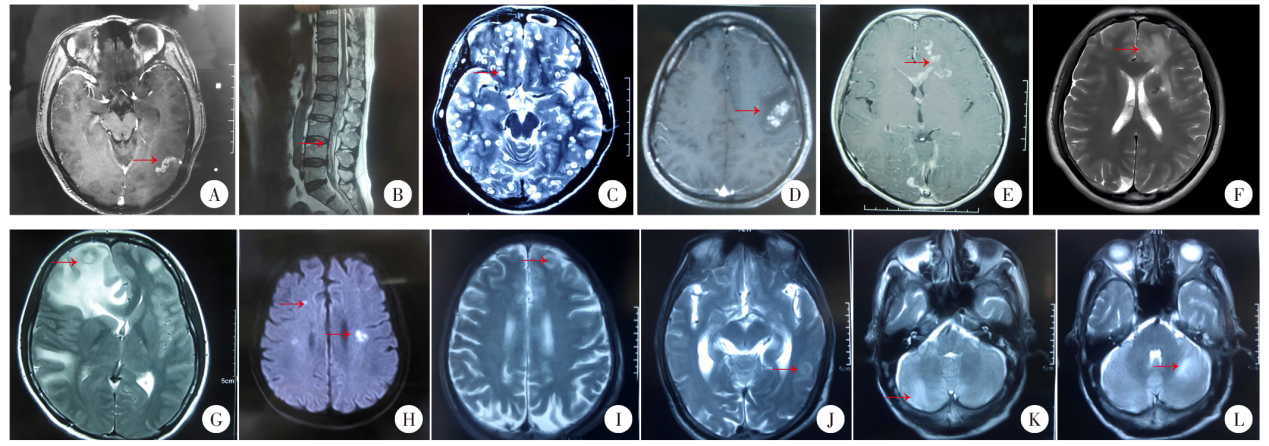
Fig. 2
Etiological and pathological findings of parasitic infections cases of the central nervous system in Jiangxi Province A: Schistosoma eggs (normal saline direct smear method, × 40); B: Tunnels in brain tissues from patients with cerebral sparganosis (HE staining, × 40); C: Spirometra mansoni; D: The parasite cuticle presents distinct lace-like folds. The worm is dorsoventrally flattened with abundant smooth muscle bundles, and numerous round calcareous corpuscles are visible inside the body (HE staining, × 100); E: Charcot-Leyden crystals (HE staining, × 400); F: Babesia (Giemsa staining, × 1 000).
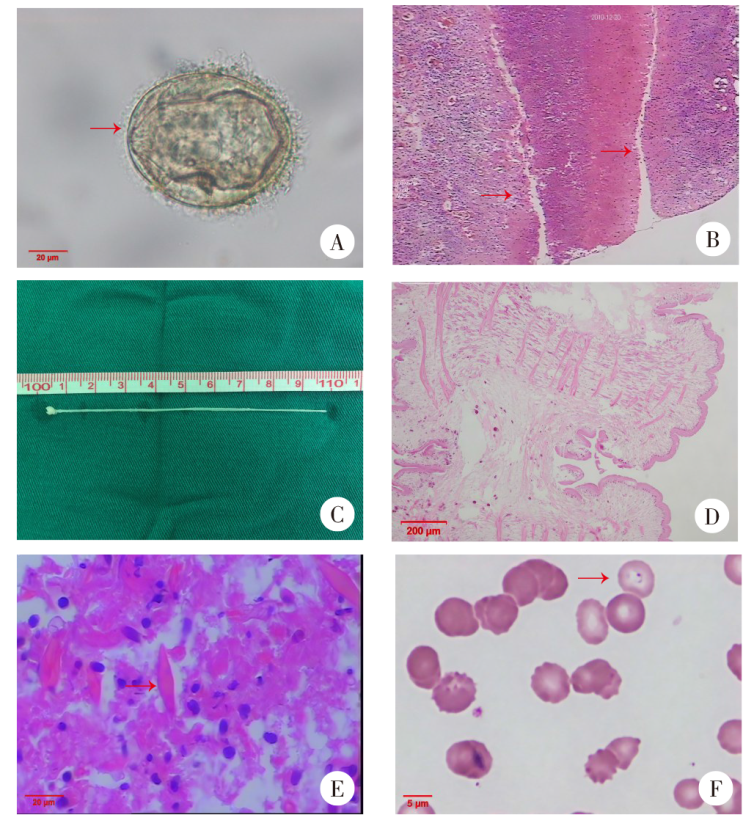
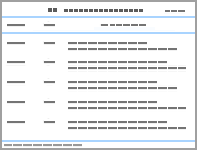
Table 1
Epidemiological surveys of 174 cases with parasitic infections of the central nervous system in Jiangxi Province
| 暴露类型 Types of exposure history | 病例数(构成比/%) No. patient(Proportion/%) | 病种 Types of diseases |
|---|---|---|
| 饮生水 Drink raw water | 56(32.2) | 脑曼氏裂头蚴病、脑并殖吸虫病 Cerebral sparganosis mansoni, cerebral paragonimiasis |
| 生食/半生食(蛙、虾蟹等)Eat raw/undercooked frogs,shrimps or crabs | 50(28.7) | 脑曼氏裂头蚴病、脑并殖吸虫病 Cerebral sparganosis mansoni, cerebral paragonimiasis |
| 养猪/屠宰史/生食猪肉 Raise pigs/pig slaughter/eat raw pork | 32(18.4) | 脑猪囊尾蚴病、脑曼氏裂头蚴病 Cerebral cysticercosis cellulosaei, cerebral sparganosis mansoni |
| 抓玩/捕食蛙、螃蟹 Catch/eat frogs or crabs | 15(8.6) | 脑曼氏裂头蚴病、脑并殖吸虫病 Cerebral sparganosis mansoni, cerebral paragonimiasis |
| 血吸虫疫水接触史 Exposure to schistosome-infected water | 14(8.0) | 脑血吸虫病 Cerebral schistosomiasis |
| 生食蛞蝓/接触福寿螺 Eat raw slugs/contact with Pomacea canaliculata | 2(1.1) | 广州管圆线虫脑病 Angiostrongylus cantonensis encephalopathy |
| 接触污染水源 Exposure to contaminated water | 2(1.1) | 自由生活阿米巴脑炎 Free-living amoebic encephalitis |
| 免疫低下 + 不明接触史 Weakened immune system + unknown exposure history | 1(0.6) | 巴贝虫脑病 Babesia encephalopathy |
| 无明确暴露史 No clear exposure history | 18(10.3) | 主要为脑囊虫病和曼氏裂头蚴病 Cerebral cysticercosis and sparganosis mansoni are the predominant types |
|
| [1] | HE Anqi, TIAN Xia, LV Shan. Epidemiology and control of angiostrongyliasis in China during the recent 20 years [J]. CHINESE JOURNAL OF PARASITOLOGY AND PARASITIC DISEASES, 2026, 44(4): 461-467. |
| [2] | HULALAI Hader, ZUO Qingqiu, GULIBANU Aimaier, LI Shizhu, ZHENG Bin, SHEN Yujuan. Progress on the epidemiological characteristics, detection techniques, and control strategies of Cyclospora cayetanensis [J]. CHINESE JOURNAL OF PARASITOLOGY AND PARASITIC DISEASES, 2026, 44(4): 468-476. |
| [3] | ZHU Zelin, GUO Yunhai, Qin Zhiqiang, HAO Yuwan, TIAN Tian, CHEN Yijun, XIA Shang, CHEN Muxin, LI Shizhu, ZHOU Xiaonong. Advances in the epidemiological studies of angiostrongyliasis in China: ecological models [J]. CHINESE JOURNAL OF PARASITOLOGY AND PARASITIC DISEASES, 2026, 44(4): 579-586. |
| [4] | CAI Wenlin, LIU Xu, HU Ke. Progress of researches on biological therapies targeting type 2 inflammation and risk of parasitic infections [J]. CHINESE JOURNAL OF PARASITOLOGY AND PARASITIC DISEASES, 2026, 44(1): 130-136. |
| [5] | XIAO Fangyu, LUO Jin, DUAN Deyong, ZHU Yanmin, DIAO Peiwen, HUANG Weixia, ZHANG Yu, WANG Junhong, REN Qiaoyun, GUAN Guiquan, YIN Hong, LIU Guangyuan. Epidemiological characteristics and genetic evolutionary analysis of tick-borne piroplasm in selected areas of northwestern China [J]. CHINESE JOURNAL OF PARASITOLOGY AND PARASITIC DISEASES, 2026, 44(1): 79-84. |
| [6] | GONG Zhihong, YUAN Min, XIE Huiqun, XU Yun, ZHOU Feng, LUO Anqi, LIU Junpu, HU Fei, LIN Dandan, LI Yifeng. Epidemiological and clinical characteristics of newly reported advanced schistosomiasis patients in Jiangxi Province from 2019 to 2022 [J]. CHINESE JOURNAL OF PARASITOLOGY AND PARASITIC DISEASES, 2026, 44(1): 8-14. |
| [7] | XIAN Yuying, TIAN Huifang, FU Weicheng, YAN Fang, XUE Chuizhao, WANG Ying, WU Xianglin, WANG Xu. Spatio-temporal distribution characteristics of alveolar echinococcosis in Xiji County, Ningxia Hui Autonomous Region, 2005-2024 [J]. CHINESE JOURNAL OF PARASITOLOGY AND PARASITIC DISEASES, 2025, 43(6): 757-765. |
| [8] | HUANG Lihua, LI Nan, GU Wei. Clinical characteristics of fascioliasis and primary liver cancer patients [J]. CHINESE JOURNAL OF PARASITOLOGY AND PARASITIC DISEASES, 2025, 43(6): 806-813. |
| [9] | TIAN Yuxiu, HUANG Dongsheng. Epidemiological characteristics of scrub typhus in Changning County, Yunnan Province from 2014 to 2023 [J]. CHINESE JOURNAL OF PARASITOLOGY AND PARASITIC DISEASES, 2025, 43(5): 723-726. |
| [10] | YAN Dongning, ZHANG Keru, LI Changling, CHEN Xiaojun. Clinical and epidemiologic features of visceral leishmaniasis: A retrospective analysis of 49 cases [J]. CHINESE JOURNAL OF PARASITOLOGY AND PARASITIC DISEASES, 2025, 43(4): 547-554. |
| [11] | LI Bowen, WANG Junhao, ZENG Xi, XU Kaya. A adolescent case of recurrent single cerebral hemorrhage caused by cerebrothoracic paragonimiasis [J]. CHINESE JOURNAL OF PARASITOLOGY AND PARASITIC DISEASES, 2025, 43(3): 446-448. |
| [12] | SHI Guangzhong, YIN Zhe, YALIKUN Maimaitiyiming, MAIMAITIJIANG Umar, KAISAIER Tuerxunjiang, CHENG Xia, ZHAO Jiangshan. Epidemiological characteristics and spatial landscapes of echinococcosis in Xinjiang in 2023 [J]. CHINESE JOURNAL OF PARASITOLOGY AND PARASITIC DISEASES, 2025, 43(2): 231-235. |
| [13] | MAO Licui, WANG Dezheng, YANG Shihong. Epidemiological characteristics of malaria in Dalian City from 2014 to 2023 [J]. CHINESE JOURNAL OF PARASITOLOGY AND PARASITIC DISEASES, 2025, 43(2): 286-289. |
| [14] | LI Qingyu, JIN Yong, MA Weiqiong, HUANG Zhiyong. A case of central nervous system and pulmonary infection caused by Angiostrongylus cantonensis [J]. CHINESE JOURNAL OF PARASITOLOGY AND PARASITIC DISEASES, 2025, 43(2): 307-310. |
| [15] | KUI Yan, XUE Chuizhao, WANG Xu, LIU Baixue, WANG Ying, WANG Liying, YANG Shijie, HAN Shuai, XU Xuenian. Progress of echinococcosis control in China, 2022 [J]. CHINESE JOURNAL OF PARASITOLOGY AND PARASITIC DISEASES, 2024, 42(1): 8-16. |
| Viewed | ||||||
|
Full text |
|
|||||
|
Abstract |
|
|||||
