中国寄生虫学与寄生虫病杂志 ›› 2026, Vol. 44 ›› Issue (3): 437-442.doi: 10.12140/j.issn.1000-7423.2026.03.018

• 教学研究 • 上一篇    下一篇

全健康融入血吸虫病教学的课程优化:基于人-动物-环境整合框架的实证研究

董珂1()(), 黄洁雯2, 李擎天2, 吕超1,3, 许静1,3, 周晓农1,3, 郭晓奎1, 朱泳璋1,*()()   

  1. 1 上海交通大学医学院-国家热带病研究中心全球健康学院上海 200025
    2 上海交通大学医学院医学技术学院上海 200025
    3 中国疾病预防控制中心寄生虫病预防控制所(国家热带病研究中心)传染病溯源预警与智能决策全国重点实验室,国家卫生健康委员会寄生虫病原与媒介生物学重点实验室,世界卫生组织热带病合作中心, 科技部国家级热带病国际联合研究中心上海 200025
  • 收稿日期:2026-03-02 修回日期:2026-06-06 出版日期:2026-06-30 发布日期:2026-06-23
  • 通讯作者: *朱泳璋(ORCID:0000-0001-7452-4964),男,博士,副教授,研究方向:全健康与全球健康。E-mail:yzhzhu@sjtu.edu.cn
  • 作者简介:董珂(ORCID:0000-0003-2868-8452),女,硕士,高级实验师,研究方向:全健康与全球健康。E-mail:kiwidong@shsmu.edu.cn
    第一联系人:

    董柯负责血吸虫病教学设计,李擎天、黄洁雯和吕超负责统计分析和血吸虫生活史系统图制作,许静、周晓农、郭晓奎指导全健康教学框架,朱泳璋负责总体设计并监督教学。

  • 基金资助:
    上海市教委上海市高校实验技术队伍建设计划项目(沪教委〔2025〕12号);上海市高等教育学会课题(2QYB24053);上海交通大学医学院临床技能国家级实验教学示范中心课题(沪交医教〔2024〕16号)

Curriculum optimization for integration of One Health into schistosomiasis teaching: an empirical study based on an integrated human-animal-environment framework

DONG Ke1()(), HUANG Jiewen2, LI Qingtian2, LV Chao1,3, XU Jing1,3, ZHOU Xiaonong1,3, GUO Xiaokui1, ZHU Yongzhang1,*()()   

  1. 1 School of Global Health, Shanghai Jiao Tong University School of Medicine-National Institute for Tropical Diseases, Shanghai 200025, China
    2 School of Medical Technology, Shanghai Jiao Tong University School of Medicine, Shanghai 200025, China
    3 National Institute of Parasitic Diseases, Chinese Center for Disease Control and Prevention; Chinese Center for Tropical Diseases Research; National Key Laboratory of Intelligent Tracking and Forecasting for Infectious Diseases; Key Laboratory on Parasite and Vector Biology, Ministry of Health; WHO Collaborating Centre for Tropical Diseases; National Center for International Research on Tropical Diseases, Ministry of Science and Technology, Shanghai 200025, China
  • Received:2026-03-02 Revised:2026-06-06 Online:2026-06-30 Published:2026-06-23
  • Contact: *E-mail:yzhzhu@sjtu.edu.cn
  • Supported by:
    Shanghai Municipal Education Commission Program for Building Experimental Technical Teams in Shanghai Higher Education Institutions (Hu Jiao Wei [2025] 12);Shanghai Association of Higher Education(2QYB24053);National Clinical Skills Experimental Teaching Demonstration Center, Shanghai Jiao Tong University School of Medicine (Hu Jiao Yi Jiao [2024] 16)

摘要:

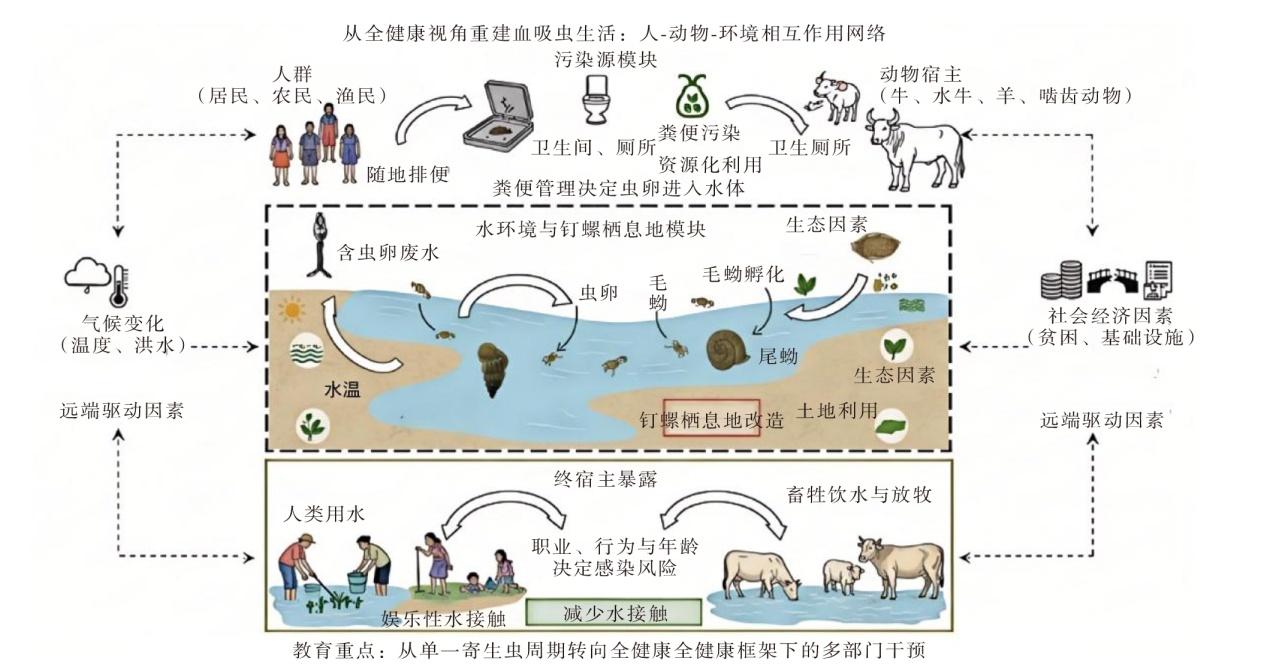
目的 在我国血吸虫病防控进入新阶段而寄生虫学核心教学内容总体稳定的背景下,基于建构主义(constructivism)和情境学习(situated learning)等理论,探索在现有“人-动物-环境”教学框架基础上系统融入全健康理念的具体路径,论证其在认知建构与能力培养层面的依据,并形成可操作的教学设计范式。方法 依托现行人体寄生虫学课程,在不调整血吸虫病核心知识点与学时安排的前提下,以建构主义、情境学习及建构性对齐(constructive alignment)为指导,通过文献分析与教学现状梳理,围绕生活史、致病机制与公共卫生防控三个模块重组“人-动物-环境”相关内容,构建支持主动建构与情境化学习的知识结构与课堂活动链,并设计情境导入、案例分析、小组情景模拟与多元评价等环节。以各学年实验班与对照班在病原生物学期末试卷中“血吸虫病考题”得分/寄生虫学考题总分的百分比为评价指标;组间比较前进行方差齐性检验,组间均值比较采用Welch两独立样本t检验(双侧)。结果 构建以血吸虫生活史为主线、符合认知负荷分配的“污染源-水环境-螺栖生境-人/动物暴露-疾病负担”多层次表征图谱,在保留教材核心知识点的基础上,将人群、动物宿主与环境因素系统嵌入,为图式整合提供支撑;据此形成“人群-动物宿主-生态环境”三界融合的全健康授课框架,并在致病机制模块引入“生态致病机制”分析视角,作为联结病理生理与生态流行病学知识的教学工具。连续4个学年评价指标结果显示:2021年实验班为73.80%,与对照班的70.32%差异无统计学意义(t = 0.800,P > 0.05);2022—2024年实验班分别为82.04%、79.46%、73.06%,均高于对照班的75.78%、70.15%、65.16%(t = 2.059、2.604、2.645,均P < 0.05),实验班优势维持6~9个百分点。结论 在不改变血吸虫病基本教学内容的前提下,基于建构主义与情境学习对现有“人-动物-环境”框架进行结构化梳理与情境化强化,可将全健康理念转化为组织教学内容与学习活动的实施框架,而非简单叠加视角。与常规授课相比,该模式授课效果有明显优势,为提升系统性理解与综合防控思维提供了可行教学方案。

关键词: 血吸虫病, 医学寄生虫学教学, 全健康, 人-动物-环境, 情境学习, 实证研究

Abstract:

Objective As the national schistosomiasis control program enters a new phase in China and the core content of parasitology curricula remains overall stable, this study aimed to explore the specific pathway for systematically integrating the One Health concept into the current human-animal-environment teaching framework, investigate the evidence for cognitive construction and competency development and develop an operable instructional design model. Methods Based on the current medical parasitology courses and non-adjustment of essential schistosomiasis knowledge points and allocated class hours, the knowledge structure and classroom activity chain supporting active construction and situated learning were constructed through reshaping human-animal-environment-related contents across three modules (life cycle, pathogenesis, and public health control) based on literature analysis and summarizing current status of medical parasitology teaching, under the guidance of constructivist meaning-making, situated learning, and constructive alignment, and a teaching procedure was developed that included scenario-based introduction, case analysis, group scenario simulation and diversified assessment. The outcome measure was the percentage of the score for schistosomiasis items in the total score for parasitology items in the end-of-term pathogenic biology examination between the experimental and control classes during each session. Homogeneity of variance was tested before between-group comparisons, and difference of means between groups was compared with two-sided Welch’s two-sample t tests. Results A “source of infection-aquatic environment-snail habitats-human/animal exposure-disease burden” multi-level representational framework was constructed, which was centered on the life cycle of Schistosoma and coincided with the distribution of cognitive load. Based on retainment of core knowledge points of the textbook, this framework explicitly embedded human populations, animal hosts, and environmental factors to provide an external scaffold for diagram integration, so as to generate an integrated human populations-animal hosts-ecological environment three-domain instructional structure. In addition, an “eco-pathogenesis” analytic perspective was introduced into the pathogenesis module as a teaching tool to link pathophysiology and eco-epidemiology. Over four consecutive sessions, results from objective assessments showed no significant difference in the proportion of the score for schistosomiasis items in the total score for schistosomiasis items in the end-of-term pathogenic biology examination between the experimental and control classes in 2021 (73.80% vs. 70.32%; t = 0.800, P > 0.05), and higher percentages in experimental classes than in control classes from 2022 to 2024 [2022: 82.04% vs. 75.78%, t = 2.059, P < 0.05; 2023: 79.46% vs. 70.15%, t = 2.604, P < 0.05; 2024: 73.06% vs. 65.16%, t = 2.645, P < 0.05], with 6% to 9% superiority over the control class. Conclusion Without altering the basic teaching contents of schistosomiasis, structural refinement and contextual reinforcement of the current human-animal-environment framework based on constructivism and situated learning may provide a feasible route to translating One Health into an operable framework for organizing teaching contents and learning activities, rather than a simple overlap perspective. Compared with conventional teaching methods, this model delivers markedly superior teaching outcomes and offers a viable instructional approach to strengthening systematic comprehension and integrated control thinking.

Key words: Schistosomiasis, Medical parasitology teaching, One Health, Human-animal-environment, Situated learning, Empirical study

中图分类号: